Wednesday, May 25, 2011

Around the World in Eighty Days


Finished Around the World in Eighty Days by Jules Verne, another fun and exciting adventure book. On a wager of 20,000 pounds, Phileas Fogg of London and his newly hired French valet, Passepartout, embark on a journey to circumnavigate the globe in 80 days. They meet with many snags and dangers and participate in various rescues of themselves and others. Fogg's trademark calm in all types of crises is both frustrating and admirable. Passepartout's unexpected valiance is heroic and sometimes hilarious. They travel by train, steamer, elephant and sled. At one point the possibility of utilizing a hot air balloon is briefly mentioned, but never actually takes place. I found this amusing since so many book covers feature a hot air balloon. This concept seems to have been introduced with Mike Todd's 1956 film adaptation of the novel. Interesting that publishers don't always read what they print.

Tuesday, May 17, 2011

The Help


Finished The Help by Kathryn Stockett. Every year there are one or two books that stand out as the very best reads. Last year it was The Secret Life of Bees and Mariana. This year, so far, it's The Help. I could not put this book down.

Set in Mississippi in the early 1960s, it's told from the perspective of three different characters and focuses on the lives of black women who work as maids and their interactions with the white women who employ them. I don't want to give away any single bit of this deeply satisfying book. I just want you to read it.

Such a Pretty Fat


Finished Such a Pretty Fat by Jen Lancaster. This time Lancaster's memoir is about her efforts to lose weight. Trying to do the same, I thought it would be a useful read and it was. Aside from being hilarious, this book highlights moments when the author realizes that she's capable of so much more than she thought. An encouraging and honest read.

Tuesday, May 3, 2011

The Adventures of Pinocchio


Finished The Adventures of Pinocchio by Carlo Collodi, originally published in 1883. This book is second only to the Oz books in its wackiness. A bizarre, yet enjoyable read.

Tuesday, April 26, 2011

The Adventures of Sherlock Holmes


Finished The Adventures of Sherlock Holmes by Sir Arthur Conan Doyle. It is the first collection of Holmes short stories, each originally published in the Strand Magazine, then published in book form in 1892. I'm not usually a fan of short stories, but because these deal with the same two characters it's more like a collection of sketches. The stories were fun to read and while often predictable, suspenseful nonetheless. When the client in "The Adventure of the Engineer's Thumb" is trapped inside the terrible stamping machine it reminded me of the hero in The Phantom of the Opera being trapped in the same sort of situation. In several stories Holmes mentions the menace that lies in wait in the quiet country hamlets, spoiling Watson's enjoyment of the scenery while they rush through the countryside by train. It seems funny to me that Holmes eventually retires to the country to keep bees when he seems to have such a horror of it.

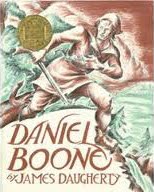
Daniel Boone


Finished Daniel Boone written and illustrated by James Daugherty. It won the Newbery Medal in 1940. This book joins The Story of Mankind as one of my least favorite Newbery Medalists. In it's telling of Boone's adventures on the American frontier, it portrays the brutality and prejudice of the time all too vividly. Boone is a hero fighting for freedom and land. Native Americans are depicted as blood-thirsty savages. I found this perspective puzzling after having read some of the preceding Newbery Medalists, in particular Calico Bush and Caddie Woodlawn, where settlers learn to live peaceably with neighboring tribes.

Daugherty was trained as a painter. His illustrations for the book are lurid, disturbing, and while skillfully rendered, difficult to appreciate.

Monday, April 11, 2011

Lady Audley's Secret


Finished Lady Audley's Secret by Mary Elizabeth Braddon. Originally published in 1862, it is a sensational novel involving murder, bigamy and madness. Braddon wrote many stories of this sort that were serialized in penny dreadfuls for the entertainment of the lower classes. This made me think of Louisa May Alcott's sensational fiction of the same period.

The prose is very straightforward and accessible. The pace is fast and the story compelling. In some ways I think the use of travel by railroad and message by telegraph increased the pace even more. Robert Audley's fondness for his missing friend George Tallboys and his attraction to George's sister Clara, in whose face he sees George, reminded me of Charles Rider's attraction to the Marchmain family in Brideshead Revisted. The story itself also reminded me of Wilke Collins' The Woman in White.

Tuesday, April 5, 2011

Mindful Eating


Finished Mindful Eating: A Guide to Rediscovering a Healthy and Joyful Relationship with Food by Jan Chozen Bays, M.D. I noticed it in a local book store and thought it might be a good guide to changing my eating habits on the path to better health. Having read The Mindful Way Through Depression last year, I was already familiar with the basic concepts of mindfulness. I think there are times when all of us eat without being in the moment. Wait, I just ate three pieces of pizza? I don't even remember doing that. This book helps you to cultivate a mindful eating practice and to recognize which of the seven types of hunger is distracting you during the day. I found this book interesting and full of easy to employ suggestions.

Jan Chozen Bays is a pediatrician and co-founder of the Great Vow Zen Monastery of Clatskanie, Oregon.

Friday, April 1, 2011

My Senator and Me: A Dog's-Eye View of Washington, D.C.


I recently read My Senator and Me: A Dog's-Eye View of Washington, D.C., written by Senator Ted Kennedy and illustrated by David Small. The book is about Splash, Kennedy's Portugese water dog, who went to work with his master every day. I first learned about this book when I read the New York Times article My Life as a Dog, by Colin H. P. Buckley back in February. Buckley writes about his experience as an intern answering letters and e-mails written to Splash by children who read the book. The book itself is charming, as are Small's illustrations. The cover image of Kennedy bears such a strong resemblance to the late senator that it made me smile. Small won the 2001 Caldecott Medal for his illustrations in So You Want to Be President? and the 1998 Caldecott Honor Medal for illustrating The Gardener.

My Day: The Best of Eleanor Roosevelt's Acclaimed Newspaper Columns, 1936-1962


Finished My Day: The Best of Eleanor Roosevelt's Acclaimed Newspaper Columns, 1936-1962. I took my time with this, reading two or three entries at breakfast on work days. I learned more about 20th century history from this book than any I read in school or after. It offers everything that Roosevelt's autobiography does not, her perspective, her opinions and her passions. An interesting and excellent read. Highly recommended.

Monday, March 28, 2011

Green Mansions: A Romance of the Tropical Forest


Finished Green Mansions by W. H. Hudson, originally published in 1904. Set in the wilds of South America, it is the story of a Venezuelan man, Abel, who flees his home after participating in an unsuccessful revolution and takes to the forest for refuge. He lives among the Indians there and cultivates a slacker existance until one day he happens upon a forest where none of his Indian companions dares to go. He is teased and led on adventures there by the warbling of an unseen sprite. This sprite is Rima the Bird Girl.

Raised in this wilderness, Rima is one with the forest and all it's creatures. She hates the Indians who hunt and kill the animals of her forest family. The Indians in turn fear her, calling her the Daughter of the Didi. Abel is fascinated by Rima and eventually falls in love with her. Just as his life regains meaning and promise all hope is dashed and he descends into a fearsome tumult of destruction and revenge. Afterwords, his guilt and grief turn him savage. His existence becomes so base that I cringed at his desperate state.

This is a very strange book. I don't want to say more in terms of the plot for fear of spoiling it for anyone. Hudson was a naturalist, born in Argentina and later settling in England. The book was made into comic books as well as film. It appeared on the summer reading list for my high school. Intrigued by the title, I tried to read it back then, but found it uninteresting. It seemed an easy read this time, but again, a very strange book. I'll let you form your own opinions of Hudson's use of the name Abel.

Wednesday, March 16, 2011

The New Chronicles of Rebecca


Finished The New Chronicles of Rebecca by Kate Douglas Wiggin. Published in 1907, it's her sequel to Rebecca of Sunnybrook Farm. Rebecca's adventures continue in Riverboro, Maine. This book spans from age thirteen to eighteen. Rebecca gets into scrapes of course, but she also uses her generous spirit to improve the lives of many people around her. Like Jo March, Laura Ingalls, Betsy Ray and Anne Shirley, Rebecca Rowena Randall dreams of becoming a writer.

Tuesday, March 15, 2011

Calico Bush


Finished Calico Bush by Rachel Field. It won the Newbery Honor Medal in 1932. It's the story of Margaurite, a girl who travels from France with her grandmother and uncle to start a new life in the American colonies. Unfortunately her uncle dies on the ship as they travel to the colonies and her grandmother dies soon after their arrival. Margaurite is alone in a strange new world. She is placed with a family as a bound-out girl. The family will house, feed and clothe her until she is 19. During that time she must work for them to help with household duties and childcare. The family she is bound-out to decides to move from Marblehead, MA to the wild and largely unpopulated coast of Maine. When they arrive they find that their house has been burned and that Indians in the area remain hostile towards settlers.

During her time with her host family Margaurite is treated fairly by the adults and younger children, although the mother, Dolly, is critical of her as a foreigner and a Catholic. The oldest son teases her often and criticizes the French for siding with the Indians against settlers. Margaurite bears many slights of this kind. She engages in numerous feats of bravery to protect the children and animals of her new family. It is not until the end of the story that she is fully appreciated for these acts.

This is the third book that I have read from this period which describes a female child being severely burned and then dying. What was it that prompted writers to include this in stories of the time?

Calico Bush is another name for Mountain Laurel. Field won the Newbery Medal in 1930 for Hitty: Her First Hundred Years.

Monday, March 7, 2011

Captains Courageous


Finished Captains Courageous by Rudyard Kipling. Spoiled 15 year old Harvey Cheney falls overboard from the luxury liner he and his mother are traveling to Europe on. Luckily he is spotted and pulled inside the dorey of a Portuguese fisherman named Manuel. Manuel takes him back to the schooner he works on. When Harvey has regained himself he demands to be taken to New York where his wealthy father will pay handsomely for his safe return. The Captain of the ship, Disko Troop, explains to him that that is impossible in the middle of their cod fishing voyage. Harvey behaves very badly and Troop socks him in the nose. From then on he realizes that he cannot get away with being a selfish trouble-making lay-about anymore.

Harvey is befriended by Troop's son Dan who is about the same age. Dan teaches Harvey all about life on the boat, how they fish, salt and store what they catch and what to do in the off hours. Harvey works along with Dan and feels a sense of purpose for the first time in his life. He begins to feel like a member of the community on the boat and works very hard.

This is a terrific coming of age book, laced with many good tales of the sea told by other characters. An excellent adventure.

Wednesday, March 2, 2011

The Fields


Finished The Fields, the second novel in Conrad Richter's The Awakening Land Trilogy. It continues the story of Sayward Luckett, now married to lawyer Portius Wheeler. This book picks up right where The Trees left off. Sayward clears more of the forest around her improvement, converting it to farmland. Other members of the settlement try to master the land and the wildlife upon it in all the wrong ways. Sayward and Portius have many children and open a meeting house and a school on their land. As a family saga, this story is compelling. As a chronicle of the settling of the Ohio territory it's a bit heartbreaking.